
Princeton University Press
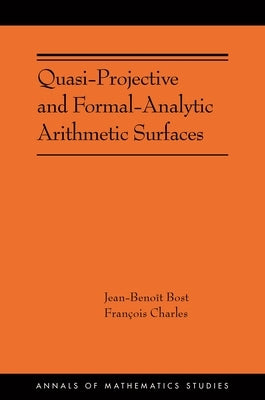
Quasi-Projective and Formal-Analytic Arithmetic Surfaces
Quasi-Projective and Formal-Analytic Arithmetic Surfaces
Regular price
$165.00
Regular price
Sale price
$165.00
Unit price
per
Shipping calculated at checkout.
Couldn't load pickup availability
A milestone in the geometric understanding of algebraization theorems that also provides an introduction to Arakelov geometry
Motivated by questions of transcendental number theory, arithmetic, and Diophantine geometry, this book provides a thorough study of a new kind of mathematical object--formal-analytic arithmetic surfaces. These are arithmetic counterparts in Arakelov geometry of germs of complex surfaces along projective complex curves. Formal-analytic arithmetic surfaces involve both an arithmetic and a complex-analytic aspect, and they provide a natural framework for old and new arithmetic algebraization theorems. Formal-analytic arithmetic surfaces admit a rich geometry that parallels the geometry of complex analytic surfaces. The dichotomy between pseudoconvexity and pseudoconcavity plays a central role in this framework. The book develops the general theory of formal-analytic arithmetic surfaces, making notable use of real invariants coming from an infinite-dimensional version of geometry of numbers. Those so-called theta invariants play the role of the dimension of spaces of sections of vector bundles in complex geometry. Relating those invariants to the classical invariants of Arakelov intersection theory involves a new real invariant attached to certain maps between Riemann surfaces, the Archimedean overflow, which is introduced and discussed in detail. The book contains applications to concrete Diophantine problems. It provides a generalization of the arithmetic holonomicity theorem of Calegari-Dimitrov-Tang regarding the dimension of spaces of power series with integral coefficients satisfying some convergence conditions. It also establishes new effective finiteness theorems for fundamental groups of arithmetic surfaces. Along the way, the book discusses many tools, classical and new, in Arakelov geometry and complex analysis, and it can be used as an introduction to some of these topics.Author: Jean-Benoît Bost,François Charles
Binding Type: Hardcover
Publisher: Princeton University Press
Published: 08/04/2026
Series: Annals of Mathematics Studies #224
Pages: 264
Weight: 1.2lbs
Size: 9.21h x 6.14w x 0.63d
ISBN: 9780691287867