
Bloomsbury Academic
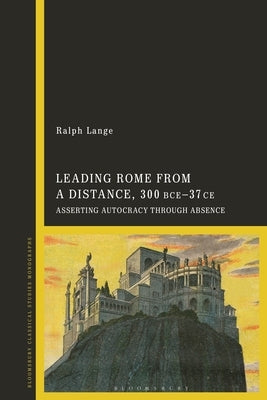
Leading Rome from a Distance, 300 BCE-37 CE: Asserting Autocracy through Absence
Leading Rome from a Distance, 300 BCE-37 CE: Asserting Autocracy through Absence
Regular price
$115.00
Regular price
Sale price
$115.00
Unit price
per
Shipping calculated at checkout.
Couldn't load pickup availability
Roman political leaders used distance from Rome as a key political tool to assert pre-eminence.
Through the case studies of Caesar's hegemony, Augustus's autocracy, and Tiberius's reign, this book examines how these figures' experiences and manipulations of absence established a multipolar focus of political life centred less on the city of Rome, and more on the idea of a single leader.
The Roman expansion over Italy and the Mediterranean put the political system under considerable stress, and eventually resulted in a dispersal of leadership and a decentralization of power. Absent generals rivalled their peers in Rome for influence and threatened to surpass them from the provinces. Roman leaders, from Sulla to Tiberius, used absence as a mechanism to act autonomously, but it came at the cost of losing influence and control at the centre. In order to hold influence while being split off from the decision-making powers of the geographical nucleus that was Rome, communication channels to mitigate necessary absences were developed during this period, such as travel, intermediate meetings, letters (propaganda writings) and a complex network of mediators, ultimately forming the circle from which the imperial court emerged. Absent leadership, as it developed throughout the Late Republic, a hitherto neglected issue, eventually became a valuable asset in the institutionalising process of the autocracy of Caesar, Augustus, and Tiberius.
Author: Ralph Lange
Binding Type: Hardcover
Publisher: Bloomsbury Academic
Published: 11/14/2024
Pages: 248
Weight: 1.16lbs
Size: 9.21h x 6.14w x 0.63d
ISBN: 9781350325401
Through the case studies of Caesar's hegemony, Augustus's autocracy, and Tiberius's reign, this book examines how these figures' experiences and manipulations of absence established a multipolar focus of political life centred less on the city of Rome, and more on the idea of a single leader.
The Roman expansion over Italy and the Mediterranean put the political system under considerable stress, and eventually resulted in a dispersal of leadership and a decentralization of power. Absent generals rivalled their peers in Rome for influence and threatened to surpass them from the provinces. Roman leaders, from Sulla to Tiberius, used absence as a mechanism to act autonomously, but it came at the cost of losing influence and control at the centre. In order to hold influence while being split off from the decision-making powers of the geographical nucleus that was Rome, communication channels to mitigate necessary absences were developed during this period, such as travel, intermediate meetings, letters (propaganda writings) and a complex network of mediators, ultimately forming the circle from which the imperial court emerged. Absent leadership, as it developed throughout the Late Republic, a hitherto neglected issue, eventually became a valuable asset in the institutionalising process of the autocracy of Caesar, Augustus, and Tiberius.
Author: Ralph Lange
Binding Type: Hardcover
Publisher: Bloomsbury Academic
Published: 11/14/2024
Pages: 248
Weight: 1.16lbs
Size: 9.21h x 6.14w x 0.63d
ISBN: 9781350325401